Will Violence Affect Colombian Coffee Production?
Colombian is the leading producer of high quality Arabica coffee. It is also the home to numerous narcotics traffickers often working out of some of the same regions where the best coffee is grown. For years honest and hard working coffee farmers have lived their lives and done their work unencumbered by narcotraffickers even though they may be working in the same regions. Now Colombia has a new right wing president, Abelardo de la Espriella, who has promised to build ten mega prisons and round up drug traffickers with the help of US president Trump and the US military. Colombians are increasingly concerned about violence as “el presidente” and his plans move forward.
Pablo Escobar’s War with the Colombian Government in the 1980s
The 1980s war on drugs in Colombia was violent and hugely disruptive to Colombian society and businesses including the coffee business. In the 1980s the Medellin Drug Cartel under Pablo Escobar was the most powerful organized crime network in Colombia with Escobar being one of the richest people in the world. Adding to the mix at the time were paramilitary groups, the Colombian government, and guerilla groups that had been at war for decades. When the government chose to declare war on Escobar the result was billions of dollar in infrastructure damage hundreds of deaths of judges, high ranking police and military and countless civilians. By time Escobar was assassinated in 1993 the damage to foreign investment and the Colombian economy was so severe that it took three decades to recover.
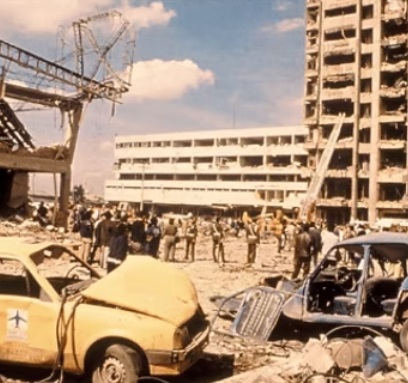
Bombing in Bogota Colombia During War with Escobar
How the 1980s Drug War Affected Colombian Coffee Production
Coffee and cocaine are best grown in similar locations and conditions. Thus, coffee farmers who only wanted to grow and sell their coffee often found themselves in the heart of military operations by government forces against cocaine traffickers and reprisals by cocaine traffickers and guerillas against military forces. Many families that had grown coffee in western Colombia for generations found the situation so dangerous that they simply left. It was not until long after Escobar’s death and a treaty between the Colombian government and FARC, the largest guerilla group that many coffee farmers returned to their farms and resumed operations. Not only were coffee farmers in remote locations in danger on their farms but travel and shipping coffee were dangerous due to roadblocks by the military, drug traffickers and guerrillas.
Is Colombia at Risk of Another Round of Violence?
Western Colombia is currently recovering from a historic 7.4 Richter scale earthquake that damaged buildings from Buenaventura from where coffee is exported up to Cali, Pereira, and Manizales in the Colombian coffee triangle, the Eje Cafetero. This occurred just after the new president was sworn in. Despite needing to address the damage to infrastructure and road in the region it appears that de la Espriella still wants to start a war with drug traffickers and may even have help from Donald Trump’s American military. For folks with a sufficiently long memory in Colombia this is raising concerns that drug traffickers backed by historic profits and wealth will fight back and plunge Colombia into the sort of chaos that reigned during the dark day of Pablo Escobar and the Medellin Drug Cartel. If this happens it could be disruptive to farming operations as well as transport and shipping of some of the finest Arabica coffee in the world. One might expect to see less Colombian Arabica coffee on the world market and at higher prices for years if not decades if the script of the coming war with cocaine traffickers follows the script of the Escobar years. We might also see higher prices due to the law of supply and demand for one only can guess for how long!
Low Coffee Price in the Face of El Niño
When it became clear that we were in store for not only an El Niño year but a super El Niño we expected to see significantly higher coffee prices due to reduced coffee production. El Niño is certainly developing as expected or even worse but the price of coffee has fallen over the last few months instead of rising. How is that possible?
How Much Will the Super El Niño Reduce Coffee Production?
Drought will be the cause of reduced coffee output in many regions of the world. While Brazil was expected to have a banner year prior to the current El Niño they are now expecting as much as a twenty percent reduction from previous crop estimates. We just wrote about how the Central American Dry Corridor will experience significant reductions of all harvests, including coffee. Estimates of reduced output across all of Latin America run from thirty percent to as much as fifty percent. While global coffee production will likely fall as a result of this El Niño event, supplies on hand and reduced demand will be tempering factors.
Coffee Prices Follow the Law of Supply and Demand
While short term supply will be reduced due to climate issues, both of the world’s biggest producers, Brazil and Vietnam, have significant coffee reserves from recent harvests which are helping the market cope with the supply issue. It remains to be seen how well these reserves will hold up if the super El Niño lasts longer than expected or ends up being more severe than currently anticipated.
How Is Coffee Demand Holding Up?
The world coffee market demand from 2026 to 2031 is expected to grow at greater than 5% a year over the coming years with the Asia Pacific seeing the greatest growth although North America will retain the biggest market share. Premium ground coffee will be the leading coffee product followed by instant coffee. As a market niche, single origin coffee will gain market share compared to mixed origin coffees. Increasingly, direct supply from point of origin is becoming more popular with coffee direct from Colombia always an excellent choice.

Coffee Shop Image Courtesy of Wikipedia
Young Asians Are Drinking More Coffee and Less Tea
Stressed young Chinese workers are more and more switching to coffee instead of tea according to NBC News. This trend goes along with more and more coffee shops in China. In just last few years the number of coffee shops in China increased by nearly sixty percent so that today China’s fifty thousand shops exceeds America’s forty thousand. In addition, more and more Chinese coffee shops are local brands like Manner, Cotti and Luckin instead of foreign owned chains like Tim Horton’s, Starbucks, or Costa Coffee. In the largest cities private coffee shops are also thriving helping drive demand for coffee in Asia. This trend should be driving coffee prices higher while the world faces lower coffee output due to the current El Niño situation. But it would seem that ample reserves are helping prop up the price of Java despite other supply and demand issues!
Why Is Coffee Leaf Rust Worse for Coffee Plants During a Drought?
We know that old Arabica coffee varieties that are susceptible to coffee leaf rust are commonly grown at very high altitudes where temperatures are lower and coffee plants both grow more slowly and are better able to fight off leaf rust infections. As a super El Niño approaches many coffee growing areas are looking at drought conditions. Not only will coffee plants be deprived of sufficient water but they will also be more prone to coffee leaf rust infestations. Why is that and are there things that a coffee farmer can do to help remedy the situation?
How Does Coffee Leaf Rust Affect Coffee Plants?
Hemileia vastratrix, the coffee leaf rust fungus is an obligate parasite. This means the fungus needs to find a host to feed upon. The spores of this fungus float up and attach to the underside of the leaves of coffee plants where the spores enter the leaves though tiny pores called stomata whose normal function is to allow water and gases to pass in and out of the leaves. Once inside of the coffee plant leaf the spores germinate and send out filaments throughout the leaves terminating in sacs called haustra which in turn absorb nutrients to feed the fungus and gradually kill the coffee plant by destroying tissue and depriving the plant of nutrients. In the process, yellow-orange pustules form on the underside of the coffee plant leaves giving the plant disease the “leaf rust” name. The process is gradual and as such a coffee plant may progressively weaken over years before dying.
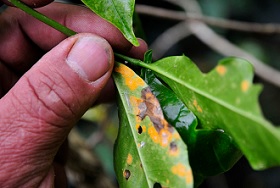
How Does Drought Make Coffee Leaf Rust Infestations Worse?
During a drought there is not any more coffee leaf rust hanging around to infect coffee plants and drought does not make leaf rust spores any more virulent. Rather drought weakens coffee plants and reduces their resistance to leaf rust. Water stress makes plant nutrient transport weaker. In addition, coffee plants are less able to fight off any pathogens as they need to work to survive the lack of water. Coffee berry disease is prevalent during droughts for the same reasons that coffee leaf rust is more of a problem. A healthy coffee plant physically blocks propagation of leaf rust filaments both physically and by creating chemical compounds that inhibit the fungus. These defense mechanisms are greatly reduced in a heat stressed coffee plant.
Does Irrigation Help Prevent Coffee Leaf Rust During Drought Conditions?
The short answer is yes. Providing enough water helps keep a coffee plant healthy and the ground encasing its roots moist. Irrigation water can also contain nutrients to help boost plant growth and defense against diseases. It is important when irrigating coffee plants to avoid too much water which can lead to roots being deprived of oxygen. Irrigation works best with well drained soil and pulse irrigation where the soil is allowed to breathe between irrigation pulses. And it is always important to follow basic coffee leaf rust prevention procedures such as cleaning up debris around coffee plants and cleaning tools when moving from field to field to avoid carrying spores from infected to previously clean areas.
How El Niño and Drought Is Affecting Coffee Production in Central America
The el Niño event that we have written about is taking hold across various parts of the world. Specifically, it is causing severe drought in a large swath of land in Central America. How is going to affect coffee production from the nations involved?
What Is the Central American Dry Corridor?
According to the World Food Program USA, the Central American dry corridor is a large strip of land along the Pacific coast of El Salvador, Guatemala, Honduras and Nicaragua and extending as far south as the Azero Peninsula of Panama. It is prone to severe spells of drought in response to climatic variations.
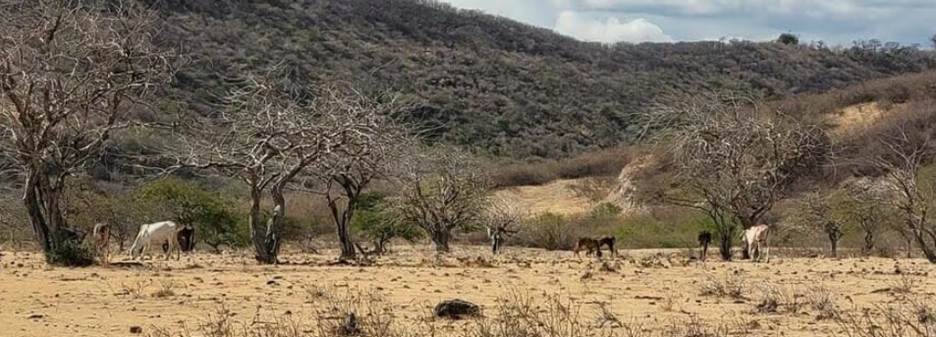
Central American Dry Corridor Courtesy of WFPUSA
The dry corridor is also home to ninety percent of Central America’s population! When a severe drought hits this region the first concern is the loss of a major area for food production and cattle grazing area that feeds the region. How do drought events in this region affect coffee production?
Coffee Growing in the Central American Dry Corridor
Central America is an extremely biodiverse region with large areas of rich volcanic soil. Thus this region produces lots of excellent coffee. Coffee production is not limited to the central mountainous regions of this part of the world but includes Pacific coastal areas known as the dry corridor. International Coffee Partners sponsors sustainable coffee farming projects specifically in the dry corridor. Coffee growers in this region mostly grow Arabica varieties and account for about ten percent of world production. Thus a significant disruption of coffee production due to severe drought will mostly affect supply and price of Arabica rather than Robusta coffee. By promoting sustainable coffee farming operations folks like International Coffee Partners are helping make local coffee operations less susceptible to catastrophic results from prolonged dry spells.
How Is the El Niño Super Event Progressing?
As we predicted in a previous article this El Niño is turning out to be one of the most powerful on record with climatic changes across the world. The extreme heat wave across Europe and a milder Atlantic hurricane season are just two examples occurring far from the Pacific coast of South America where changes in the ocean current commonly herald a coming El Niño event. While coffee production in the dry corridor is a worry for the coffee world, Reuters reports that massive crop failures across the dry corridor threaten more than seventy thousand small farms.
When Will Normal Growing Conditions Resume in the Central American Dry Corridor?
Meteorologists predict that the super El Niño event will remain strong into early 2027 and start to relent by late spring and even be gone by mid-summer. Coffee plants are very sensitive to lack of water. When a drought is short lived, a plant may speed up maturation and produce smaller berries. If the drought is severe and lasting this can result in the loss of whole harvest seasons and even fields of coffee plants. To the extent that irrigation is possible this can help preserve harvests and coffee farms but this approach requires money that many small coffee farmers to not have. To the extent that this super El Niño is a harbinger of climate events to come, coffee farming will end up being limited to areas less prone to droughts thus decreasing the amount of coffee harvested and raising the price of coffee that is available.
Is Coffee Production at Risk of Forest Fires?
Normally we think of climatic risk to coffee as being hotter temperatures, increasing risk of coffee leaf rust, crop failure from drought, and less and room at the tops of mountains to grow fine Arabica coffee. 2026 has been a year of forest fires across Europe, North America, Asia, South Africa, Australia, Chile, Argentina and in the coffee belt in Indonesia. Going forward, is production of coffee at risk of forest fires as well as excess heat, drought and disease?
Why Are There So Many Forest Fires?
The United States National Park Service says that eighty-five percent of United States wildfires are caused by humans. Causes include burning cigarettes carelessly discarded, unattended fires burning trash and debris, campfires left unattended, sparks from electrical equipment, and arson. Lightning strikes cause the other fifteen percent of wildfires in the USA. Drought makes wildfires worse both because there is more dry fuel for fires and because water needed to fight fires may be scarce. There have not necessarily been a lot more fires in 2026 but they have been harder to contain because of dry conditions.
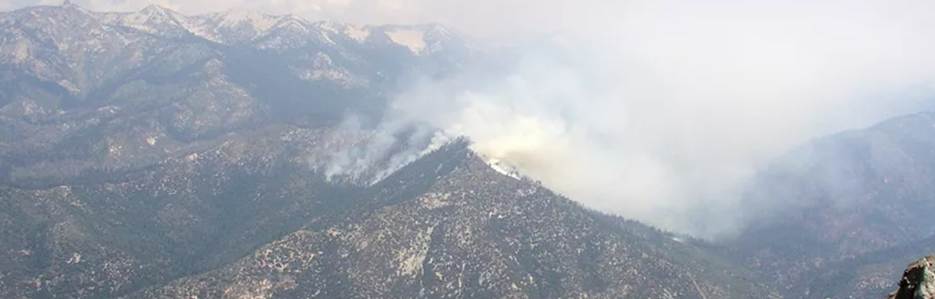
Drought and Forest or Wild Fires
As noted by the US Park Service fires are typically worse and harder to contain when conditions are dry to begin with. However, long term drought conditions result in vegetation dying back and therefore less fuel for new fires. Because coffee plants are planted and tended by active human activity we would not expect fewer fires in coffee areas due to plants dying back. But to the degree that coffee farmers give up on an area because of drought that would result in less fuel for fires.
How Often and Where Are the Fires in Coffee Growing Regions?
Just two years ago in 2024 a severe drought led to fires in Sao Paulo state in Brazil. This was an El Niño year when there were forest fires in regions like Colombia where it is typically wet virtually all year long. This year with another El Niño in the wings Colombia is keeping close track of fire risks throughout the country including in the coffee growing axis. In Indonesia the Sumatra and Kalimantan regions have had fires recently causing damage to coffee farms. Indonesia typically has very distinct wet and dry seasons. When dry seasons are worse such as during El Niño years wild fires are common and can very well burn into coffee farms causing significant damage.
Do Climate Change or El Niño Cause Wild Fires in Coffee Producing Areas?
Steadily increasing amounts of carbon dioxide in the atmosphere from burning fossil fuels is steadily driving temperatures up. Higher temperatures appear to be contributing to more droughts. However, climate change is not responsible for any given wild fire or forest fire. On the other hand, El Niño events generally add power to storms which can include lightning that causes fires. In both cases the effects on fires in coffee producing regions will be limited to dry conditions over both the long and short term. Rainfall reduction due to deforestation in areas like Brazil likely have a stronger effect on the drought and wildfire relationship.
Shade Grown Coffee and the Risk of Forest Fires
Wild coffee is naturally a plant that grows in the shade of the forest. Shade grown coffee is commonly excellent coffee. Sadly, as forest fires become more common in coffee growing regions of the world this excellent coffee will be at risk. To protect areas planted with shade grown coffee a coffee farmer will need to create fire breaks where there are areas free of combustible materials. This may be a good way to protect coffee crops in general from wild fires but will reduce income for the coffee farmer who will not derive any income from fallowed land.
Why Does Coffee Give You the Jitters?
Coffee is the second most consumed beverage in the world after water. At least a billion people drink at least a cup of coffee each day. There are many long term positive health effects from drinking coffee including protection from developing type II diabetes and various types of cancer and neurodegenerative diseases like Alzheimer’s and Parkinson’s diseases. The other side of the coin is that drinking too much coffee can cause side effects such as gastritis and the jitters. What is it about coffee that causes side effects? Just why does coffee give you the jitters.
What Are the Jitters?
Jitters refers to a state of hyper alertness, restlessness, and nervousness accompanied by a fast heart rate, physical shaking of the legs, sweaty palms, and a shaky voice. Jitters can be cause by emotional stress or by chemical stimulants. In regard to coffee it is the caffeine in coffee that blocks neurotransmitters that can have calming properties and rather stimulates the nervous system mimicking psychological stress.

Caffeine Effects on the Human Body
When you ingest caffeine it blocks adenosine which is a neurotransmitter that relaxes us and makes us sleepy. This is part of the “wake up” effect of a morning cup of coffee. Blockage of adenosine results in neurons firing faster while the brain releases norepinephrine and dopamine. These neuro transmitters are responsible for arousal and alertness. In excess their release causes the same symptoms as extreme anxiety with a fast heart rate and extreme restlessness.
Fight or Flight Response to Drinking Too Much Caffeine
Humans have confronted dangerous situations throughout virtually all of the existence of the species. When confronted with a dangerous situation a person goes into an automatic response that helps equip them for survival. This physiological response to danger was described at the beginning of the 20th century by Walter Cannon, a physiologist. The sequence of events prepares the body to most efficiently run away or fight for one’s life. A common problem in modern life is that all too often situations or chemicals that do not represent a threat to one’s life still provoke the same physiological response that being pursued by a bear, lion, or pack of hyenas might have in ancient times. Drinking too much coffee with a high caffeine content falls into this category. Physical threats to one’s life cause activation of the brain location called the amygdala which then turns on a host of neuro transmitter responses. Too much caffeine shortcuts this process by directly turning on responses that increase the heart rate and increase awareness. Thus a response that helped humans survive in the early days of the species is replicated with two or three cups of strong coffee back to back.
Are The Jitters from Coffee Dangerous?
The nervous effects of drinking too much coffee with too much caffeine are typically short term, lasting no more than a few hours and typically peaking in an hour or so. If a person suffers from high blood pressure or cardiac rhythm issues these can be complicating factors. However, over the long term jitters from coffee do not pose a health risk but rather an inconvenience. If person has a problem with severe esophageal reflux this problem can be worsened by too much caffeine. Long term reflux can lead to esophagitis and a stricture which be a serious health risk albeit not related to the jitters.
How to Avoid Making Bitter Coffee
Everybody likes a good cup of coffee in morning or later in the day. Many of us like to brew our own coffee. When the result of our efforts is a good tasting cup of java that is all the better. But what happens when your home brewed coffee does not taste right, when it has a bitter taste? Here are a few thoughts about how to avoid making bitter coffee.
What Makes Food or Drink Have a Bitter Taste?
Naturally occurring components of food or drink such as flavonoids, polyphenols, or alkaloids and their metabolites are experienced as bitter by taste receptors on the tongue, mostly on the back third of the tongue. The degree to which individuals experience foods or drink as bitter can vary significantly from one person to another. This ability to taste bitterness has a genetic or hereditary basis in the ability to recognize toxic or poisonous substances. While coffee is not toxic or poisonous it has bitter components and can be very bitter depending on level of roast, coarseness of grind, as well as both temperature and duration of brewing.
What Makes Coffee Bitter
Naturally bitter ingredients in coffee include caffeine, chlorogenic acid, polyphenols, quinic acid, and phenylindoles. The degree of bitterness of these substances in green coffee beans is not excessive but can increase significantly with dark roasting, excess temperature while brewing, and longer than needed extraction time. In addition, stale beans tend to result in more bitter cups of brewed coffee.
How Avoid Bitterness in Your Brew
To avoid excessive extraction of bitter components of your coffee brew at the low end of the recommended brewing range of one hundred ninety-five to two hundred five degrees Fahrenheit. Use a coarser grind to have less surface area of your coffee exposed to the water in order to extract fewer bitter ingredients. And shorten your brewing time if you need to reduce bitterness even more.
More Water and Less Coffee to Reduce Bitterness
The standard for making coffee is to use about fifteen times as much water as coffee. If you have done everything else and are still getting bitter coffee you may wish to up the ratio of water to coffee although you will be at risk of getting a weak coffee devoid of flavor for your trouble. If you go this route do it in small steps.
Choice of Coffee Beans and Bitter Coffee
If you prefer Robusta coffee which has substantially more caffeine than Arabica coffee you will tend to have a more bitter cup of coffee. Also if you choose an Arabica with less caffeine you may be getting a bean rich in mozambioside, a chemical which is nearly ten times as bitter as caffeine!
What If You Have a Variant of the TAS2R43 Bitter Taste Receptor?
It turns out that about a fifth of us have a more sensitive bitter taste receptor called the TAS2R43 receptor. If you have this variant of the receptor you will experience more bitterness than anyone in the other four fifth of the population. You will need to be more aggressive in all of the measures we mention above in order to get coffee that you experience as less bitter.

Masking Coffee Bitterness with Extra Ingredients
Three stand things that we add to our coffee also mask bitterness. These ingredients are sugar, milk and cream. Milk and cream reduce coffee bitterness two ways. They bind with bitter chemicals and masks bitterness with their own taste. Sugar meanwhile masks bitterness by competing with its sweet taste.
Why Does My Coffee Taste Sour?
Coffee is the third most consumed drink on earth after water and tea. In the USA coffee ranks behind water and ahead of tea. Although there are folks who only drink coffee for its stimulant effects coffee flavor is important to most coffee drinkers. Thus it is a problem when your coffee does not taste right. Specifically, when you coffee has a sour taste that is a problem. When your Java is sour what is the problem?
How Incorrect Coffee Brewing Gives You Sour Coffee Flavor
As we noted in our recent “too hot coffee” article there is an ideal temperature range for brewing coffee which is between one hundred ninety-five and two hundred five degrees Fahrenheit. In this temperature range the hot water extracts flavors and oils from coffee grounds without extracting compounds that are bitter. If your coffee is brewed below this temperature that is when you will get a sour taste because you are extracting acidic elements and not elements that are sweet or otherwise able to balance the acidic elements. If your hot water passes through the grounds too rapidly you have the same “under extraction” problem and sour coffee.
Grind Your Coffee Well to Avoid Sour Coffee
Another reason for “under extraction” and sour coffee is when your coffee grounds are ground too coarsely. This gives you less surface area exposed to hot water and is especially important with pour over coffee when you have only one shot at extraction as opposed to using a French press or making coffee slowly with a percolator. If you brew with water that is too cold and have a coarse grind you will double your problem and are more likely to have a sour taste to your coffee.
Light Roast or Old Coffee Beans and Sour Coffee
If you like a light roast you are enjoying fruity flavors which are naturally acidic. Under extraction of a coarse ground light roast coffee at too low temperatures is likely to lead to a sour taste for even the best and freshest Arabica coffee. Another problem is when your beans have lost their freshness. These beans have lost their sweetness which typically balances out the sourness potential of a light roast. If your light roast coffee is turning out sour make sure your beans are ground fine, that your brewing temperature is well within the correct range and that you keep your coffee grounds in the hot water for at least a couple of minutes longer than you have been. Typical brewing times for a French press are four to five minutes, pour over coffee three to four minutes, and for a drip coffee maker four to six minutes. Add two minutes to your method if you light roast is turning out sour.

Make Sure You Are Brewing Fresh Coffee
All too often the problem when your coffee tastes sour has nothing to do with using a light roast, brewing for too short a time or brewing at too low a temperature. The problem is that your coffee is no longer fresh. When you purchase and store coffee always put your coffee in cool and dry place. Green coffee beans retain their freshness for up to three years when stored properly. Roasted whole coffee beans will stay fresh for up to six months with proper storage. When you buy ground coffee it begins to lose its freshness as soon as it is exposed to the air. Thus when you buy ground coffee, leave it on the shelf for weeks or months and do not take care with choosing a cool and dry place you should not be surprised if you cup of coffee is rather sour.
Home Made Irish Coffee
A wonderful drink for a cool autumn or cold winter evening is Irish Coffee. But there will be times when you probably do not want to leave the comfort of your home to visit your local coffee shop to buy an Irish Coffee. As it turns out Irish Coffee is not difficult to prepare once your have the correct ingredients. So let’s learn how to make home made Irish Coffee.
What Is Irish Coffee?
Irish Coffee came to be when chef Joe Sheridan at the Foynes airport at Limerick, Ireland served coffee with a shot of Irish whiskey and topped with whipped cream to transatlantic passengers stranded at the airport during bad weather. This was in the 1940s. A travel writer introduced the drink in San Francisco in the 1950s from where it became generally known and consumed. The name came from the chef when a passenger asked him if the coffee was Brazilian coffee and he said it was “Irish Coffee.”

Image Courtesy of Martha Stewart
Ingredients for Your Irish Coffee at Home
For the best Irish Coffee you will want the best ingredients. Colombian Arabica coffee is a good starting point. When choosing an Irish Whiskey brand remember that great Irish Whiskey does not just have pure alcohol but rather flavors and notes similar to how each great coffee has its own distinct tastes, aromas and flavors. Famous and excellent Irish whiskeys include Jamison with vanilla and nut notes, Redbreast with suggestions of dried fruit, marzipan, and spices in the twelve-year-old and notes of berries, chocolate, and hazelnut in the eighteen-year-old. Other top Irish whiskey brands include Bushmills, Green Spot, Powers, and Release. For your whipped cream you will want heavy whipping cream, extract of vanilla, and powdered sugar for the whipped cream and extra brown sugar to add to the coffee and whiskey mixture. Here are the ingredients you will need for each cup of Irish Coffee
- Four to six ounces of brewed dark roast Arabica coffee
- One and a half to two ounces of Irish whiskey
- Two to three tablespoonfuls of heavy whipping cream
- One to two teaspoons of brown sugar
- Two or three drops of vanilla extract
How to Make Irish Coffee at Home
Making Irish Coffee involves brewing coffee, making whipped cream and combining ingredients. All of this should take you less than ten minutes as you do your tasks in parallel. First start brewing your coffee. Then combine your whipped cream ingredients in a bowl and use your mixer to whip the cream until a spoon stuck into the whipped cream stands up. When your coffee is ready add whiskey and brown sugar all in your coffee cup. Then add a layer of whipped cream to the top of the coffee and whiskey mix and you have your home made Irish Coffee!
Is Drinking Coffee with Alcohol a Good Idea?
As stranded transatlantic travelers discovered eighty years ago Irish Coffee is delicious and a nice way to feel warmer on a cold evening. However, one needs to be aware of the issues related to consuming coffee with caffeine along with alcohol. Caffeine is a stimulant and alcohol is a depressant. Drinking coffee when consuming alcohol can have the effect of masking how drunk you are becoming. In addition, drinking alcohol can make you feel warmer when you are not actually warmer thus being potentially dangerous if you are in a really cold environment. So, enjoy your home made Irish Coffee but be careful about how much you drink and do not fool yourself into thinking that the warm flush from alcohol is really making your body warmer on a dangerously cold evening!
Is There a Faster Way to Enjoy Irish Coffee?
If your preference is having Irish Coffee ready to consume with out having to go through the preparation you can purchase products like “Irished Up” which is canned Irish coffee which comes premade only needing to be heated. Our preference is to use freshly roasted Colombian Arabica coffee and a good Irish whiskey along with fresh ingredients to create our own home made Irish Coffee.
When Is Coffee Too Hot?
Years ago we reported how a McDonald’s customer sustained severe burns from scalding coffee from the takeout window at her local outlet. Because it turned out that this was a recurring issue with McDonalds the customer won a multimillion dollar lawsuit. Although boiling hot coffee can be dangerous and is not a good idea there are more reasons why you do not want overly hot coffee in your cup. So, when is coffee too hot?
How Hot Does Coffee Have to Be to Cause Burns?
Hot coffee spilled on exposed skin can cause burns at temperatures as low as 120 degrees Fahrenheit or forty-nine degrees Celsius. The severity of skin burns depends on temperature and time of skin exposure. The same temperatures apply to burning your mouth with too hot coffee. While it takes up to ten minutes to cause a severe burn at 120 degrees Fahrenheit it takes less than a second to cause a second or third degree burn at 150 degrees Fahrenheit or higher. A first degree burn causes skin redness. A second degree burn causes blistering. A third degree burn causes permanent skin or even nerve damage, secondary infection, and scaring. Thus, it is a good idea to be careful not to spill hot coffee on your skin or drink a scalding hot cup of coffee before letting it cool off.
What Does Excess Heat Do to Your Coffee?
If we assume that you are not going to drink scalding hot coffee or spill the same on yourself there are still issues with too hot coffee. If you brew your coffee at temperatures over 205 degrees Fahrenheit or 96 degrees Celsius, bitter compounds such as tannins and other plant material are extracted from the coffee grounds. You may end up with a chalky, dry, and bitter taste even with high quality Arabica coffee. Caffeine extraction is not affected by excess temperature. You will lose much of the high end aroma and taste from coffee’s aromatic compounds as well with brewing temperatures above the recommended range. And if you are reheating your coffee you can lose all of the remaining aromatic compounds and thus all of the remaining taste and aroma are lost by reheating at high temperatures.
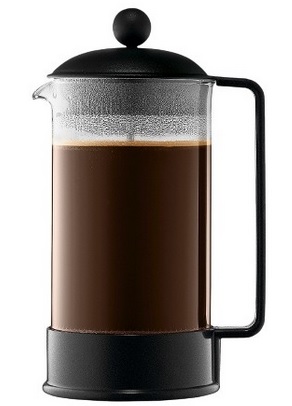
What Temperature Is Best for Brewing Coffee?
For best results brew your coffee between 195 degrees and 205 degrees Fahrenheit or 90 to 96 degrees Celsius. You need to water to be hot enough to extract oils and flavor from your coffee grounds and not so hot as to extract bitter flavors. If your brewing temperature is too low you will get weak, sour or even salty taste.
Level of Coffee Roast and Brewing Temperature
To further refine your brewing temperature, use the higher end of the brewing range at 200 to 205 degrees Fahrenheit for a light roast to obtain the delicate flavors at this end of the roast spectrum. Brew at the lower end between 185 195 degrees Fahrenheit for dark roasts as dark roast grounds are easier to dissolve and provide their flavors.
How to Brew Coffee in the Right Temperature Range
The best way to brew in the ideal temperature range is to boil your water and, using a stem or digital kitchen thermometer measure temperature once you stop heating. Wait until the temperature comes to the top of your desired brewing range and then add water to your French press or pour the water over your grounds for pour over coffee. For these two methods four minutes is typically sufficient to accomplish the task at the correct temperature range.